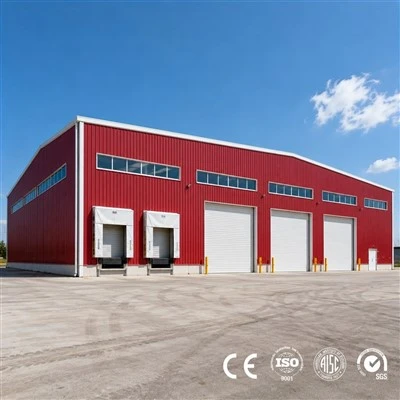


Storing an aircraft usually comes down to one of two structures: a T-hangar or a box hangar. Both start from the same steel frame. The shape locks in what you can do with the space, sometimes for a decade or more.
Pick wrong and the mistake shows up two ways. You either pay for square footage you never use, or you outgrow the building the day your aircraft or your plans change. This guide walks through what actually separates the two structures, what drives their cost, and where each one stops working.
T-Hangar vs. Box Hangar at a Glance
| T-Hangar | Box Hangar | |
|---|---|---|
| Typical use | Single aircraft, personal storage | One or several aircraft, mixed use |
| Layout | Wing-nested, staggered units | Open clear span |
| Door width | Narrower, sized to one aircraft | Wider, sized for clearance and future aircraft |
| Land use | Efficient per aircraft on narrow lots | Needs an open footprint, efficient per activity |
| Cost pattern | Priced per unit | Priced per square foot, swings with finish level |
| Best for | One dedicated bay, no expected changes | Flexible or shared space, room to grow |
Every section below unpacks one row, including the exceptions that break the pattern.
What Is a T-Hangar?
A T-hangar's shape lets one aircraft's wings overlap the empty space next to it, which is where the name comes from. Airports build them this way to squeeze more private bays into a limited stretch of taxiway.
That same shape caps what the building can become later. Change one bay after construction and you're rebuilding it, not remodeling it.
How a T-Hangar Is Laid Out
Each bay narrows toward the front to hold the fuselage, then opens into two side pockets that catch the next aircraft's wingtips. That nesting is the only reason T-hangars save space at all. Strip it out, and a row of single-aircraft bays eats the same footprint per aircraft as a box hangar would.
Two layouts handle the nesting differently. Standard rows run nose to tail to nose down a long site. Nested rows pair tail to tail instead, which shortens the taxiway but demands a wider site to fit the extra width. Build nested on a site that's too narrow, and the space savings disappear before construction even starts.

When Does a T-Hangar Make Sense?
One condition decides this: own exactly one aircraft, and don't expect its wingspan or tail height to outgrow the bay. Upgrade to a wider aircraft later, and the fixed dimensions turn against you, forcing a rebuild instead of an adjustment. Adding a second aircraft is a separate problem entirely. That means renting or building another bay, not losing the one already standing, so it hits your total cost, not the shape of what you own.
Site shape only matters if you're building rather than renting. A long, narrow lot puts the nesting layout to work. A wide, square lot wastes it, since frontage was never scarce there to begin with. Rent into an existing row, and the airport already made this call for you.
What Is a Box Hangar?
A box hangar frames an open rectangle with a clear span, so no column interrupts the floor. Picture a conventional steel building, just sized for aircraft instead of pallet racks.
That open floor is what you're paying for. It lets one building hold different things over time, whether or not you ever need it to.
How a Box Hangar Is Laid Out
The footprint is one continuous span. Aircraft park side by side, nose in, however the owner arranges them, since nothing in the structure forces one layout over another.
That freedom costs more than a T-hangar bay of equal square footage, because the roof spans the full width with nothing underneath it to help carry the load. You're buying room to rearrange later, not just square feet today.
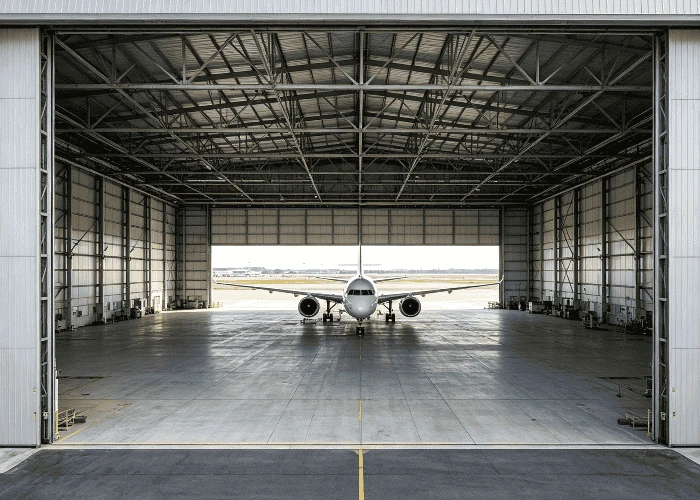
When Does a Box Hangar Make Sense?
Three things justify the extra cost: owning more than one aircraft, flying something too large for a T-hangar bay, or needing floor space for maintenance alongside storage. Any single one covers the functional case. It doesn't automatically cover the financial one. On expensive or leased land, that larger footprint can cost more than the problem it fixes, so price the land per square foot before assuming the extra space pays for itself.
Skip it for a single small aircraft with no plans to grow. You'd be buying open span nobody uses, on an aircraft a T-hangar bay covers for less.
What Are the Main Differences?
Line the two structures up side by side and six differences do the actual deciding. Each one points to something specific to check before signing anything.
Layout and Space Efficiency
A T-hangar squeezes more bays into the same frontage because each unit borrows space from its neighbor, a wingtip resting exactly where the next fuselage ends. Box hangars can't borrow like that. Every span stands alone, sized only for what sits inside it.
Scarce frontage is what makes this matter. Plenty of open lot, and nesting buys nothing, since linear footage was never the fight in the first place. Pull the site plan before assuming a row of T-hangars saves space. Sometimes it doesn't.
Land Use and Site Footprint
T-hangars slot into a long, narrow lot, since the bays crowd together in one row and the taxiway feeding them stays short. Box hangars need clearance on every side, for the door to swing and for whatever gets added later.
Lease the land instead of owning it, and this stops being an abstract layout preference. A wide box hangar footprint on leased ground adds a recurring cost a T-hangar row simply doesn't carry. Square lot instead of narrow, though, and the advantage vanishes. The other variables decide instead.
Aircraft Access and Maneuvering
Getting an aircraft into a T-hangar bay usually means a straight tow. The narrow front leaves no room to turn once you're inside. A box hangar's open floor lets you taxi in and reposition instead, which starts to matter the moment more than one aircraft has to move independently.
One aircraft that rarely moves barely notices the difference. Add ground equipment, a second plane, or maintenance work sharing the floor, and that maneuvering room finally gets used instead of just paid for.
Aircraft Door Requirements
A T-hangar door tracks close to one aircraft's wingspan, which keeps it small and cheap, but only for that aircraft. Swap in a wider wingspan later, and the door turns into the reason the plane doesn't fit, not the frame around it.
A box hangar door spans the whole bay, so it costs more upfront but swallows a wider range of aircraft without modification, unless someone undersizes it to shave the quote. Measure the aircraft's actual wingspan plus clearance before signing anything, not the number off the spec sheet, and check it against the door schedule the builder is quoting. A door cut two feet too narrow can't be fixed without cutting steel. Our aircraft hangar door guide breaks down span and clearance by aircraft type.
Flexibility and Future Expansion
A T-hangar locks in its shape the day the last bolt goes in. The nesting geometry that saves space also chains each bay to its neighbors, so widening one drags the whole row into the rework.
A box hangar's clear span stays open on purpose. Add a second aircraft, wall off a shop corner, reshuffle the floor plan, none of it touches the steel frame, as long as nobody undersized the span to save money at the start. No real reason to expect the fleet or the use of the space to change? That flexibility is a cost paid for nothing. Expect the change, and it's the difference between adapting and rebuilding. Our aircraft hangar size guide covers how span length affects structural cost and how much expansion room actually comes with it.
Storage vs. Maintenance
A T-hangar leaves barely enough room to walk around the aircraft, let alone pull a panel or roll a lift into place. It holds the aircraft still. It doesn't let anyone touch it.
A box hangar's open floor can do both, but only if someone planned the clearance for maintenance from the start. Add that work in later, without having sized the span for it, and the floor turns out technically open but too tight for much beyond parking.
T-Hangar vs. Box Hangar Cost
Comparing sticker prices here means comparing two different pricing models, not two numbers on the same scale. A T-hangar prices per unit, since each bay repeats the same design. A box hangar prices per square foot, and that number swings hard depending on what goes inside the shell.
What Drives T-Hangar Cost?
Three things set a T-hangar unit's price: the size of the structural bay, the door, and whatever utilities the site needs. The steel frame itself stays cheap per unit, since the design repeats down the row and nothing gets re-engineered bay to bay.
The door and the finish are where the number actually moves. Size a bay for a wider or taller aircraft, and both the door and the opening grow with it, costing more than the frame around them. Pour a paved apron, run electrical service, or upgrade the slab, and the price climbs even though the steel tonnage barely budges.
None of that touches regional labor rates or steel market pricing, and both shift the baseline before a single bay-specific choice enters the picture. Use this to compare one T-hangar against another, not to guess an absolute number without a quote.
What Drives Box Hangar Cost?
Span drives a box hangar's per-square-foot price, not floor area on its own. Widen the clear span, and the steel has to get heavier to carry the roof load without interior columns, so the same square footage costs more to span at 80 feet than at 50.
The door usually delivers the biggest jump. A bi-fold or hydraulic door sized for a large-span opening runs several times what a T-hangar's door costs, and that number doesn't shrink just because a smaller aircraft ends up parked inside. Insulation, climate control, and interior finish pile on top of that. A bare shell with a manual door looks cheap right up until the building has to do something more than just stand there.
Which Is More Cost-Effective?
One aircraft, and a T-hangar wins on both build cost and rent, since nobody's paying for span or door capacity that sits unused. That holds as long as there's real confidence a second aircraft, or a bigger airframe, isn't coming within the life of the building.
Add a second aircraft, and the pattern flips, though not because the box hangar gets cheap. Splitting that same floor space across several T-hangar bays means paying for multiple doors, multiple slabs, and duplicated site work, and those costs usually stack faster than one larger span does. Per aircraft stored, the box hangar tends to win, even as the total project cost climbs higher.
Treat that as a pattern to check, not a rule to trust blindly. Door pricing, labor rates, and site costs vary enough by region that the actual crossover point, how many aircraft before a box hangar wins, moves around. Pull quotes for both configurations before committing to either one.
Overbuilding the span "just in case" breaks this math entirely. Pay for more span than the aircraft on your list actually need, and the cost advantage disappears either way, T-hangar or box. Size the span to the aircraft you actually have.
T-Hangar vs. Box Hangar for Different Aircraft
Single-engine piston aircraft are what T-hangars were built around in the first place, which is why most general aviation airports laid out their rows to that size first. Fly that type with no upgrade on the horizon, and the fit is close to exact.
Twin-engine aircraft can squeeze into a T-hangar, but only in the larger bay sizes, and only for specific models. Check the bay's door opening and depth against the aircraft's real dimensions before assuming anything fits. A twin that runs a foot too wide on paper simply won't, no matter what the listing says.
Helicopters need a box hangar almost every time. Rotor clearance and tie-down patterns don't nest the way a fixed-wing aircraft's wings do.
Business jets and larger turboprops need one too, and there's no real workaround here. Wingspan, tail height, and door clearance all outrun what any T-hangar bay offers, however the bay gets marketed.
Own more than one aircraft, or aircraft of different sizes? Renting several T-hangar bays usually runs more than one right-sized box hangar, once multiple doors and multiple lease payments enter the math instead of one.
How to Choose the Right Hangar Type
Start with what's actually owned right now, then look five years out, not just at today's aircraft.
One small or midsize single-engine aircraft, no second plane planned, no workshop needed: a T-hangar covers it at the lowest cost, and paying for more buys nothing.
More than one aircraft, something bigger than a light single, maintenance space on the list, or fleet growth already on the horizon: the box hangar's higher upfront cost buys a building that survives those changes without a rebuild.
Site shape breaks the tie when the rest is close. A long, narrow lot favors the T-hangar's footprint. A square or flexible lot removes that constraint entirely, and aircraft count and future plans decide instead.
How to Compare T-Hangar and Box Hangar for Your Aircraft
Run the project against these eight variables. No single one decides it alone, but they rarely point in different directions once all eight get answered honestly.
- Aircraft count. One aircraft points to a T-hangar. More than one points to a box hangar.
- Wingspan and tail height. Check the aircraft's actual dimensions, plus any aircraft that might get added later.
- Land shape. A long, narrow lot favors a T-hangar. A square or open lot favors a box hangar.
- Interior use. Storage only fits a T-hangar. Storage plus maintenance needs a box hangar's open floor.
- Door type and width. A single-aircraft door keeps cost down. A wide bi-fold or hydraulic door costs more but fits more aircraft sizes.
- Budget model. T-hangars price per unit. Box hangars price per square foot, and that number moves with finish level.
- Growth plans. Expecting to add aircraft or rent out space points toward the box hangar's open span.
- Use case. Personal storage, rental income, or both changes which structure pays off faster.
The steel aircraft hangar types a provider quotes should map directly to how these eight points get answered, since span, door size, and interior layout all follow from them, not the other way around.
T-Hangar vs. Box Hangar: Final Verdict
One aircraft, no changes expected, tightest budget: the T-hangar's fixed shape isn't a limitation yet. It's exactly the size needed, nothing wasted.
Multiple aircraft, a larger airframe, or plans still in motion: the box hangar's higher cost buys room to change course without rebuilding. Worth paying for, right up until those plans stop moving. After that, it's flexibility nobody's using.
Both structures start from the same steel building fundamentals. Talk to our team about sizing and pricing before committing to either shape.
FAQ
Can a T-hangar be converted into a box hangar later?
Not easily. The wing-nesting structure is built into the steel frame, so converting to an open span usually means rebuilding rather than modifying.
Can one box hangar hold more than one aircraft?
Yes. That is one of its main advantages over a T-hangar, as long as the clear span and door width are sized for the aircraft you plan to store together.
Do T-hangars or box hangars hold their value better if I plan to rent them out?
T-hangars rent reliably to single-aircraft owners at general aviation airports, since demand for individual bays tends to be steady. Box hangars rent for more per month but serve a smaller pool of tenants who need that specific size and flexibility.